|
The Phantom of the Opera (9-Dec-2004)
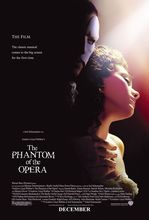
Director: Joel Schumacher Writers: Andrew Lloyd Webber; Joel Schumacher From novel: Le Fantôme de L'Opéra by Gaston Leroux From a play by: Andrew Lloyd Webber (musical) Music by: Andrew Lloyd Webber Producer: Andrew Lloyd Webber Keywords: Musical Film adaptation of the Andrew Lloyd Webber musical of the same name tells of a soprano singer's tortured relationship with a disfigured musician haunting the Paris Opera House.
ABSTRACT
Christine, a gifted young soprano with dreams of joining the prestigious ranks of the Paris Opera House, enters work on one of the Opera's grandest productions after leading lady Carlotta is gravely injured in a stage accident rumored to be the doing of the building's resident "Phantom". Christine's standout performance draws the attention of the all-too-real Phantom, a horribly-disfigured genius composer living in a lair beneath the Opera House, as he abducts her and offers to write her an opera of his own creation; a budding romance between the pair draws the ire of Christine's lover Raoul and local authorities as the mad Phantom threatens to turn his violence on the object of his obsession.
CAST | Gerard Butler | ... The Phantom | | Emmy Rossum | ... Christine | | Patrick Wilson | ... Raoul | | Miranda Richardson | ... Mme. Giry | | Simon Callow | ... Andre | | Ciarán Hinds | ... Firmin | | Jennifer Ellison | ... Meg Giry | | James Fleet | ... Lefevre | | Victor McGuire | ... Piangi | | Kevin McNally | ... Buquet | | Murray Melvin | ... Reyer | | | and | | Minnie Driver | ... Carlotta | | | Imogen Bain | ... Carlotta's Maid | | Miles Western | ... Carlotta's Wigmaker | | Judith Paris | ... Carlotta's Seamstress | | Halcro Johnston | ... Passirino | | Paul Brooke | ... Auctioneer | | Oliver Chopping | ... Porter | | Alison Skilbeck | ... Nun / Nurse | | Lee Sellers | ... Chauffeur | | Ramin Karimloo | ... Christine's Father | | Chris Overton | ... Young Phantom | | Jesika Cannon | ... Young Christine | | Annabel Porter | ... Young Meg | | Laura Hounsom | ... Young Mme. Giry | | Lucy Casson | ... Ballet Tart | | Lorraine Stewart | ... Ballet Tart | | Jose Tirado | ... Principal Male Dancer | | Jonathan D. Ellis | ... Fop | | David Langham | ... Fop | | Margaret Preece | ... Confidante | | | Opera Chorus | | David Arneil | ... Opera Chorus | | Annalene Beechey | ... Opera Chorus | | Mark Carroll | ... Opera Chorus | | Valerie Cutko | ... Opera Chorus | | Tricia Deighton | ... Opera Chorus | | John Griffiths | ... Opera Chorus | | Mandy Holliday | ... Opera Chorus | | Terry Kelly | ... Opera Chorus | | Sophie Louise Dann | ... Opera Chorus | | Jackie Marks | ... Opera Chorus | | Graham McDuff | ... Opera Chorus | | Brian Wheeler | ... Opera Chorus | | Julia Worsley | ... Opera Chorus | | | Ballet Boys | | Chris Jarvis | ... Ballet Boy | | Sebastien Torkia | ... Ballet Boy | | | Ballet Girls | | Greet Botterman | ... Ballet Girl | | Elena Buda | ... Ballet Girl | | Tess Cunningham | ... Ballet Girl | | Liesl Dowsett | ... Ballet Girl | | Pia Driver | ... Ballet Girl | | Kathryn Dunn | ... Ballet Girl | | Sophia Hurdley | ... Ballet Girl | | Amy Lawson | ... Ballet Girl | | Lucy Potter | ... Ballet Girl | | Kirsty Tapp | ... Ballet Girl | | | Opera Populaire Orchestra | | Richard Bayliss | ... Opera Populaire Orchestra | | Ralph Broadbent | ... Opera Populaire Orchestra | | Alexander Cameron | ... Opera Populaire Orchestra | | Paul Costin | ... Opera Populaire Orchestra | | Matthew Draper | ... Opera Populaire Orchestra | | Ben Gant | ... Opera Populaire Orchestra | | Jonathon Hill | ... Opera Populaire Orchestra | | Timothy Kipling | ... Opera Populaire Orchestra | | Jonathon Kitchen | ... Opera Populaire Orchestra | | Tristan Keyte | ... Opera Populaire Orchestra | | Michael Mansbridge | ... Opera Populaire Orchestra | | Jeff Moore | ... Opera Populaire Orchestra | | Julian Poole | ... Opera Populaire Orchestra | | James Pullman | ... Opera Populaire Orchestra | | Robert Purvis | ... Opera Populaire Orchestra | | Dave Tosh | ... Opera Populaire Orchestra | | Chris Worsey | ... Opera Populaire Orchestra | | | Flamenco Dancers | | Andrew Charles Corbett | ... Flamenco Dancer | | Sarah Frasca | ... Flamenco Dancer | | Pascal Langdale | ... Flamenco Dancer | | Damien Lee Stirk | ... Flamenco Dancer | | Isabel Lesto | ... Flamenco Dancer | | Remy Martyn | ... Flamenco Dancer | | Carlos Otera | ... Flamenco Dancer | | Sandra Ramirez | ... Flamenco Dancer | | Beth Sheather | ... Flamenco Dancer | | Annika Strandberg | ... Flamenco Dancer | | | Masquerade Dancers | | Stephen Berkeley | ... Masquerade Dancer | | Rod Buchanan | ... Masquerade Dancer | | Deborah Bundy | ... Masquerade Dancer | | Philip Catchpole | ... Masquerade Dancer | | Nathan Clarke | ... Masquerade Dancer | | Blake Clayfield | ... Masquerade Dancer | | Dawn Collins | ... Masquerade Dancer | | Gem Collingwood | ... Masquerade Dancer | | Andrew Corbett | ... Masquerade Dancer | | Casper Cornish | ... Masquerade Dancer | | Rachel Crocker | ... Masquerade Dancer | | Janine Davis | ... Masquerade Dancer | | Leigh Daniels | ... Masquerade Dancer | | Damien Delaney | ... Masquerade Dancer | | Simone De La Rue | ... Masquerade Dancer | | Miles Elkington | ... Masquerade Dancer | | Bethany Elliot | ... Masquerade Dancer | | Joanna Ernest | ... Masquerade Dancer | | Candice Evans | ... Masquerade Dancer | | Giulia Florimo | ... Masquerade Dancer | | Ben Garner | ... Masquerade Dancer | | Clinton Goldsmith | ... Masquerade Dancer | | Claire Goodman | ... Masquerade Dancer | | Juliet Gough | ... Masquerade Dancer | | Georgina Hagerty | ... Masquerade Dancer | | Maddy G. Harris | ... Masquerade Dancer | | Damien Jackson | ... Masquerade Dancer | | Luke Jackson | ... Masquerade Dancer | | Ryan Jenkins | ... Masquerade Dancer | | Gavin Lee | ... Masquerade Dancer | | Caroline Lynn | ... Masquerade Dancer | | Alec Mann | ... Masquerade Dancer | | Paul Micha | ... Masquerade Dancer | | Luis Gallo Mudarra | ... Masquerade Dancer | | Marilena Nicolaon | ... Masquerade Dancer | | Gabriel Noble | ... Masquerade Dancer | | Melanie Perks | ... Masquerade Dancer | | Maryam Pourian | ... Masquerade Dancer | | Adam Pudney | ... Masquerade Dancer | | Pippa Raine | ... Masquerade Dancer | | Lorena Randi | ... Masquerade Dancer | | Michael Small | ... Masquerade Dancer | | Aaron Sillis | ... Masquerade Dancer | | Lisa Stevens | ... Masquerade Dancer | | Damien Stirk | ... Masquerade Dancer | | Tom Tanscy | ... Masquerade Dancer | | Marcus Tesch | ... Masquerade Dancer | | Ashley Wallen | ... Masquerade Dancer | | Stephen B. White | ... Masquerade Dancer | | Gavin Wilkinson | ... Masquerade Dancer | | Scott Wyer | ... Masquerade Dancer | | Joanna Woodliffe | ... Masquerade Dancer | | | Candelabra Holders | | Lee Chapman | ... Candelabra Holder | | Rebekah Dobbins | ... Candelabra Holder | | Ruben Halse | ... Candelabra Holder | | Lea Jerova | ... Candelabra Holder | | Damian Jones | ... Candelabra Holder | | Vanessa Perroncel | ... Candelabra Holder |
REVIEWS Review by Natalie (posted on 22-Jun-2007) I have seen the stage version and the Movie version, and I have to say, I love the movie far more. For me the comparison is like taking a Home town candy store and chanfing it to a Godiva store. The stage version had everything you could want, but the movie version made it more elegant, lush, emotional, sexually charged. Emmy was perfect for young Christine, Patrick was dashing, Gerry was spledid, and sexy, and gave the perfect emotional, tragic influence needed for the movie version. The supporting cast also excellent.
Review by Tyler (posted on 28-Apr-2007) I saw the Phantom live in Des Moines, IA, a few months ago, which afterwards drew me to the movie. And let me just say that the music and storyline are amazing. I wouldn't go so far as to say it's the best movie I've ever seen, but it's worth a trip to the movie rental store. However, on a downside, if you are involved in theater or as critical of movies as I am, some choices made in the singing could have been better, and acting is weak at points. Overall, however, it is a very good movie and a lot like the original musical.
Review by anonymous (posted on 2-Nov-2006) Director Joel Schumacher 2004 adaptation of Andrew Lloyd Webbers stage musical The Phantom of the Opera (POTO) was brilliant and flawless. Taking a Broadway hit from stage to film can often result in failure but this was not the case. Bringing POTO to film only made it better because the audience doesnt have to use their willing suspension of disbelief nearly as much. There is no need to believe that they were underground or outside because the film actually takes you there. With a beautiful score already created and a promising expected audience, Schumacher didnt have much to worry about there. All he needed to do was find an all star cast to present it to the masses and he succeeded. The leading lady was the beautiful young Emmy Rossum who played the 16 year old soprano Christine perfectly. Rossum showed the naïve and innocent nature of Christine with an ease that makes every audience fall in love with her. The Phantom was played by Gerard Butler in a way that invokes sympathy at the start of the film, making the audience fall in love with him and his lonely but beautiful music, but as the film goes on and his obsession with Christine goes from a sweet admirer to a jealous rage, the audiences emotions will follow that of Christines and her lover Raoul played by Patrick Wilson. This rage is ignited by the Phantom feeling betrayed by Christine because he gave her his music and trained her lovely voice for years, anonymously, and she gives her love not to him, once he revealed himself, but to her childhood sweetheart, Raoul. The Phantom doesnt only share his anger with the two young lovers but with everyone else in his theatre who stands in the way of his goal of spending eternity with his Angel of Music. As if the plot wasnt interesting enough, the set is gorgeous. Taking place in 1870 Paris the costumes reflect the beauty of the city and its great appreciation for opera music. The Phantoms under-the-opera-house lair is magnificently presented in a way that the stage wouldnt be able to demonstrate. From the hundreds of candles that rise from the water and ignite automatically to the precise detail of the miniature wax figures the Phantom uses to act out his operas were a visual masterpiece. The rich and colorful costumes that were used in the operas were so elaborate that it will put the audience in awe. Even when the colors on screen where black and white, like in the graveyard scene where the only colors were Christines black dress, the white snow and the gray tombstones, they were breath taking. The uses of the multiple camera angles proved that taking the POTO from stage to screen was a must. These shots gave a clearer view of all that was happening so that the audience doesnt miss a single thing. The emotions that the movie calls for brings the audience in so deep that they might just lose themselves in the world of the Phantom. Any moviegoer can appreciate the pure beauty of POTO regardless if they claim to not like musicals. Exceeding all expectations, the musical is a heart touching story of love, loss, acceptance, and most of all the beauty of music. There is no way every audience wont fall in love the dramatic love fueled romance that is The Phantom of the Opera.
Review by Andrew Lloyld Webber (posted on 12-Nov-2007) Gerad Butler does a masterful job protraying an arrogant man humbled by love. In the movie's opening numbers, the Phantom is cocky, confident, seemingly in total control of his life as he tells Christine, "my control over you grows stonger." In spite of his belief he is the one in control of their lives, he learns to his distress his belief is in error. He cannot control Christine's heart, try as he will. At movies end, heartsick, Phantom surrenders his claim to Christine's life. Her example of willing sacrifice for the sake of the one she truly loves teaches him what love, in part, is. As the Opera Ghost grows as a person his aching lonliness and need for love are revealed, showing an all too human heart behind the mask. The final scene shows the lifelong adoration he feels for Christine and her memory. In the end, Christine's husband Raoul, no longer fears of resents Phantom's feelings for Christine. Instead, he seemes to understand and share in those feelings. This movie is a visual treat. The photography, settings, costumes and musical score perfectly fit the story. Gerad and Emma deserved awards for their perfet portrayals of the lead characters. Minnie Driver is superb in her role of Charlotta, the egotistical diva. She very nearly stole the entire movie.
Copyright ©2026
|



