|
Apocalypse Now (15-Aug-1979)
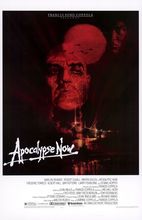
Director: Francis Ford Coppola Writers: John Milius; Francis Ford Coppola From novel: Heart of Darkness by Joseph Conrad Music by: Carmine Coppola; Francis Ford Coppola Producer: Francis Ford Coppola Keywords: Action/Adventure, Vietnam War, Explosions, Assassination Capt. Willard receives the assignment to journey upriver in the Cambodian jungle and "terminate... with extreme prejudice" Col. Kurtz, a highly decorated Green Beret who has not only gone AWOL but has been running his own private army of tribals. Loose adaptation of Joseph Conrad's Heart of Darkness. Won Oscars for Best Cinematography and Best Sound; received nominations for Best Picture, Best Director, Best Supporting Actor, Best Screenplay, Best Editing and Best Set Decoration. Watch the 1979 version, not the much-inferior 2001 re-release, which is an abomination.
CAST | Marlon Brando | ... Col. Kurtz | | Robert Duvall | ... Lt. Col. Kilgore | | Martin Sheen | ... Capt. Willard | | | Also Starring | | Frederic Forrest | ... Chef | | Albert Hall | ... Chief | | Sam Bottoms | ... Lance | | Laurence Fishburne | ... Clean | | | and | | Dennis Hopper | ... Photo Journalist | | | Co-Starring | | G. D. Spradlin | ... General | | Harrison Ford | ... Colonel | | | Jerry Ziesmer | ... Civilian | | Scott Glenn | ... Colby | | Bo Byers | ... Sergeant MP #1 | | James Keane | ... Kilgore's Gunner | | Kerry Rossall | ... Mike from San Diego | | Ron McQueen | ... Injured Soldier | | Tom Mason | ... Supply Sergeant | | Cynthia Wood | ... Playmate of the Year | | Colleen Camp | ... Playmate | | Linda Carpenter | ... Playmate | | Jack Thibeau | ... Soldier in Trench | | Glenn Walken | ... Lt. Carlsen | | George Cantero | ... Soldier with Suitcase | | Damien Leake | ... Machine Gunner | | Herb Rice | ... Roach | | William Upton | ... Spotter | | Larry Carney | ... Sergeant MP #2 | | Marc Coppola | ... AFRS announcer | | Daniel Kiewit | ... Major from New Jersey | | Father Elias | ... Catholic Priest | | Bill Graham | ... Agent | | Hattie James | ... Clean's Mother (voice) | | Jerry Ross | ... Johnny from Malibu | | Dick White | ... Helicopter Pilot |
REVIEWS Review by anonymous (posted on 12-Nov-2006) In 1977, Francis Ford Coppola disappeared into the Philippine jungle and emerged 2 years later with this film, certainly his greatest work. Based on Joseph Conrad's Heart of Darkness, the cameras follow Captain Willard (Martin Sheen) as he journeys upriver in search of the mysterious Colonel Kurtz (Marlon Brando). The film opens with a drunk and humble Captain Willard in a hotel room. We quickly gain understanding of who Willard is, and what he wants: a mission. "It was a real choice mission, and when it was over, he'd never want another." He's brought into base and given his destination, the heart of the Cambodian jungle, to terminate the command of Colonel Kurtz, who we discover has gone completely insane, and has ranked himself as a God among a small Cambodian tribe. Willard is given a boat, owned and captained by Chief Phillips (Albert Hall). Willards crew is made up of mostly kids, just out of high school, and unprepared for what awaits them. None of the crew members know Willards destination, due to it's confidentiality, so until they arrive, Willard is just going along for the ride. One the journey to Kurtz, we meet Bill Killgore (Robert Duvall), a war-hungry Colonel, who has a fascination with violence, bravery, and surfing. Killgore is assigned to transport Willards boat by helicopter down river. Two crew members less, Willard arrives at the Kurtz Compound, in one of the most notorious and unforgettable scenes in cinematic history. Willard is brought in to the lair, and sees the shadow of the man he had been searching for. Willard says earlier in the film that when he saw Kurtz, he would know what to do. After arriving, he wasn't sure. Willard is fascinated with Kurtz. Kurtz tells Willard of the horrors that he has seen, things that the audiance members could only pray to never witness for themselves. Willard soon knows that Kurtz is no longer a man. He has lost his soul. Willard knew what he had to do, and did just that, in one of the darkest endings of all time. After it's over, there is no closing monologue, no last thoughts from Willard, or a reflection of what he's just done. There's silence. Coppola leaves us with no reflection, which tells us that there's nothing more to say. Without doubt, the gem in Coppola's career and one of the greatest films of all time, Apocalypse Now leaves the audiance the same way that it leaves Willard, speechless. It's the insane beauty of Apocalpyse Now that makes it a masterwork of cinema and says more in its running time about the brutality of conflict and the hypocrisy of politicians than Michael Moore could hope to say in a lifetime.
Copyright ©2026
|


